Design a Rate Limiter
Protect APIs with token bucket or sliding window — asked at Google, Meta, Stripe, and almost every backend LLD round tied to system design.
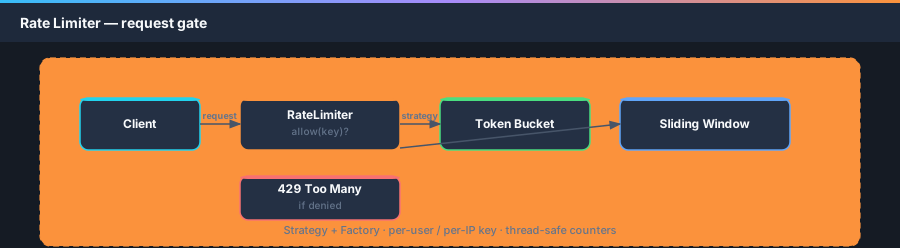
Expose boolean allow(String key). Implement Token Bucket (smooth burst) or Sliding Window (accurate count). Use Strategy + Factory so gateway code stays stable when algorithms change.
The interview question
“Design a rate limiter for an API.” Given a user or IP key, return whether a request is allowed within N requests per time window.
Often a follow-up to HLD gateway questions — here they want working code and algorithm trade-offs.
Clarifying questions (ask before coding)
key passed to allow().false vs throw — document contract.Requirements & assumptions (state aloud)
- API:
allow(String key) → boolean. - Rules: max R requests per W seconds (configurable).
- Thread-safe for concurrent requests same key.
- v1: in-process; mention Redis for multi-instance.
- Out of scope: billing tiers UI — extension only.
High-level design
Gateway calls RateLimiter.allow(clientId) before forwarding. Denied → HTTP 429.
Token bucket: refill tokens at steady rate; allow burst up to bucket size.
Sliding window: store timestamps of recent hits; count in last W seconds.
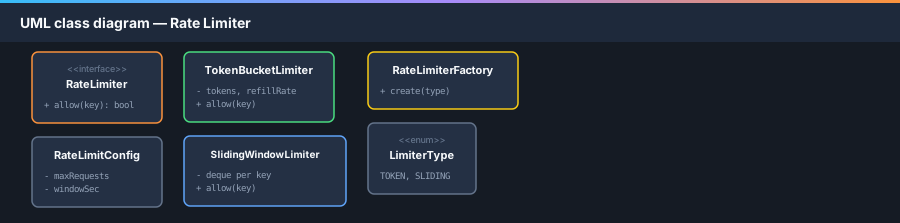
RateLimiterinterfaceTokenBucketRateLimiter/SlidingWindowRateLimiterRateLimiterFactoryfor algorithm swap
UML class diagram (optional)
Draw interface + 2 implementations + factory — under 5 minutes on board.
Design patterns used (and why)
| Pattern | Where | Why (interview soundbite) |
|---|---|---|
| 🎯Strategy | RateLimiter implementations | Swap algorithm without changing gateway. |
| 🏭Factory | RateLimiterFactory | Construct limiter from config / env. |
Full solution — interface & token bucket
public interface RateLimiter {
    // Returns true if request for key is within limit; false → reject (429)
    boolean allow(String key);
}

public record RateLimitConfig(int maxRequests, int windowSeconds) {}

public enum LimiterType { TOKEN_BUCKET, SLIDING_WINDOW }public class TokenBucketRateLimiter implements RateLimiter {
private final int capacity;
private final double refillPerSecond;
private final Map<String, BucketState> buckets = new ConcurrentHashMap<>();
// capacity = max burst; refillPerSecond = steady refill rate
public TokenBucketRateLimiter(int capacity, int refillPerSecond) {
this.capacity = capacity;
this.refillPerSecond = refillPerSecond;
}
// Refills bucket for key, consumes one token if available
@Override
public boolean allow(String key) {
BucketState state = buckets.computeIfAbsent(key, k -> new BucketState(capacity));
synchronized (state) {
state.refill(refillPerSecond, capacity);
if (state.tokens >= 1) {
state.tokens -= 1;
return true;
}
return false;
}
}
private static class BucketState {
double tokens;
long lastRefillNanos;
// Starts full at capacity
BucketState(int capacity) {
this.tokens = capacity;
this.lastRefillNanos = System.nanoTime();
}
// Adds tokens based on elapsed time, capped at capacity
void refill(double rate, int cap) {
long now = System.nanoTime();
double elapsed = (now - lastRefillNanos) / 1_000_000_000.0;
tokens = Math.min(cap, tokens + elapsed * rate);
lastRefillNanos = now;
}
}
}Full solution — sliding window & factory
public class SlidingWindowRateLimiter implements RateLimiter {
    private final int maxRequests;
    private final long windowMillis;
    private final Map<String, Deque<Long>> hits = new ConcurrentHashMap<>();

    // maxRequests allowed within rolling windowSeconds
    public SlidingWindowRateLimiter(int maxRequests, int windowSeconds) {
        this.maxRequests = maxRequests;
        this.windowMillis = windowSeconds * 1000L;
    }

    // Drops timestamps outside window; denies if count already at max
    @Override
    public boolean allow(String key) {
        Deque<Long> q = hits.computeIfAbsent(key, k -> new ArrayDeque<>());
        synchronized (q) {
            long now = System.currentTimeMillis();
            while (!q.isEmpty() && now - q.peekFirst() >= windowMillis)
                q.pollFirst();
            if (q.size() >= maxRequests) return false;
            q.addLast(now);
            return true;
        }
    }
}public class RateLimiterFactory {
// Builds the limiter implementation from type + config
public static RateLimiter create(LimiterType type, RateLimitConfig cfg) {
return switch (type) {
case TOKEN_BUCKET -> new TokenBucketRateLimiter(cfg.maxRequests(), cfg.maxRequests() / cfg.windowSeconds());
case SLIDING_WINDOW -> new SlidingWindowRateLimiter(cfg.maxRequests(), cfg.windowSeconds());
};
}
}
public class RateLimiterDemo {
// Fires 5 requests against same key to show allow/deny
public static void main(String[] args) {
RateLimiter limiter = RateLimiterFactory.create(
LimiterType.SLIDING_WINDOW, new RateLimitConfig(3, 60));
for (int i = 0; i < 5; i++)
System.out.println("req " + i + ": " + limiter.allow("user-42"));
}
}While you code — questions interviewers ask
Extensions & follow-ups
- Leaky bucket variant.
- Hierarchical limits (global + per user).
- Redis cell (fixed window counter) for cheap distributed v1.
Common mistakes (fail signals)
- Non-thread-safe counter under concurrency.
- Fixed window only — double traffic at boundary (mention fix).
- No
keyabstraction — hard-coded global counter.